Gioia Apartments ·
CIN: What Italy's National Identification Code Is and How to Get It
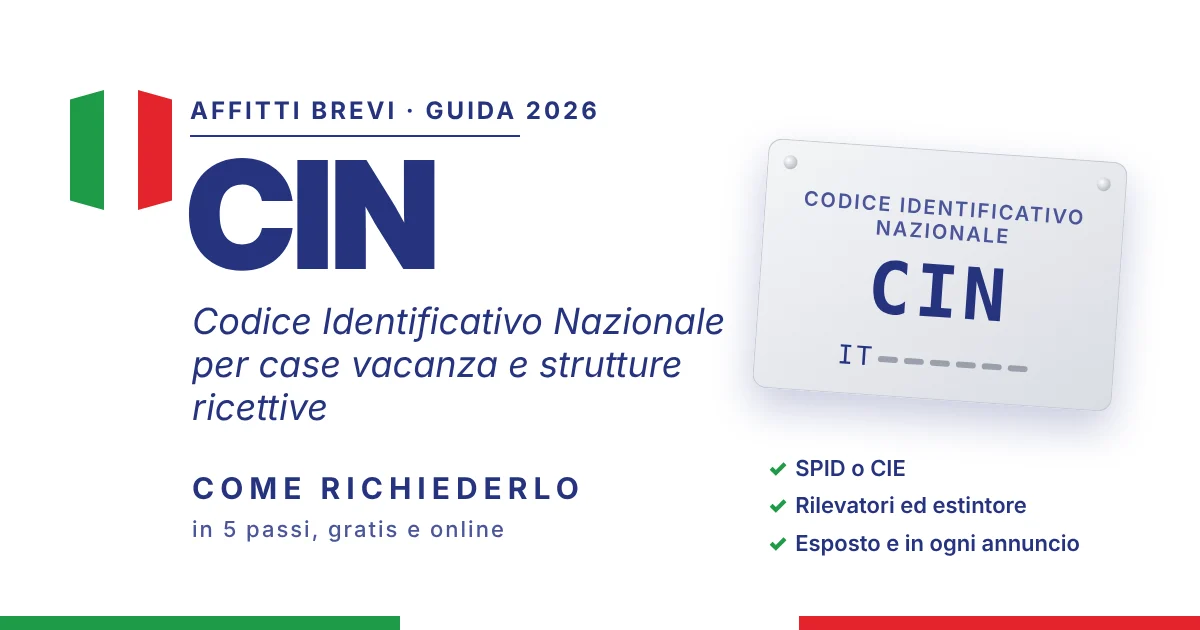
If you rent out a holiday home in Italy, the CIN is one of the first things to sort out. Without this code you can't legally publish listings or host guests. In this guide we explain what it is, who needs it, how to request it step by step, and what happens if you don't have one.
This article is for information only. Regional and municipal rules may vary: always check your own situation with the local council (Comune) or a professional.
What the CIN is
The Codice Identificativo Nazionale (National Identification Code) is a unique alphanumeric code that Italy's Ministry of Tourism assigns to every accommodation business and every property rented out for tourism. It was introduced by art. 13-ter of Decree-Law 145/2023 and has been mandatory since 2025.
It identifies each property uniquely across the whole country, helps fight illegal rentals and brings all data together in a single database: the BDSR (Banca Dati nazionale delle Strutture Ricettive, the national accommodation database).
Who needs a CIN
The CIN applies to:
- properties let as short-term rentals (up to 30 days);
- properties let as tourist rentals;
- accommodation businesses, both hotels and non-hotel accommodation: B&Bs, guest rooms (affittacamere), holiday homes.
If you rent your home on Procida to tourists, even for just a few weeks a year, you need a CIN.
CIN and regional codes: in Campania you also need a CUSR
The CIN does not replace regional codes where they exist. In Campania the regional code is called CUSR (Codice Unico delle Strutture Ricettive) and is assigned by the local council.
In practice:
- first you register with the council and obtain your CUSR;
- then you request the CIN on the national portal, where regional data is often imported automatically;
- finally you display both codes.
How to request a CIN: step by step
The request is free and done entirely online.
1. Get ready
- SPID or CIE (Italy's digital identity or electronic ID card) of the owner or operator. Foreign citizens can register on the portal and receive dedicated login details.
- The property's land registry details (dati catastali).
- Proof of right to use the property: a deed of ownership, or a contract with the owner's authorisation for tourist letting.
- Your CUSR, if already assigned.
2. Log in to the BDSR portal
Go to bdsr.ministeroturismo.gov.it and sign in with SPID or CIE.
3. Check or enter your property details
If the property is already in the regional database, you'll find the details pre-filled: check that they're correct. If it doesn't appear, you can report it with the "Struttura mancante" (missing property) function, and the Region or competent authority will review it.
4. Declare the safety requirements
During the process you self-certify that the property has the mandatory safety devices (see below).
5. Receive your CIN
At the end, the code is generated and you receive a confirmation email. You can then download a PDF summary from the BDSR with the Ministry's reference number.
Mandatory safety requirements
Short-term and tourist rentals must have:
- working gas and carbon monoxide detectors;
- compliant fire extinguishers: at least 6 kg or 6 litres, minimum rating 13A, one every 200 m² and at least one per floor.
This applies even if you were already renting before the CIN was introduced and even if you don't operate as a business.
Where to display the CIN
Once you have it, the CIN must be:
- displayed outside the building, for example on a plaque next to the entrance, in line with planning and landscape rules;
- shown in every listing: on Airbnb, Booking.com, your own website and anywhere else you advertise the property.
Since 20 May 2026, under EU Regulation 2024/1028, platforms check the code automatically: a listing without a valid CIN may not be published.
Fines
- Property without a CIN: €800 to €8,000.
- CIN not displayed outside or not shown in listings: €500 to €5,000.
Fines apply per property. There are also penalties for missing safety devices.
From the third property you also need a SCIA
Since 2026, anyone renting out more than two apartments is treated as running a business: on top of the CIN, they must file a SCIA (certified notice of business start) with the council's business office (SUAP).
Frequently asked questions
How much does a CIN cost?
Nothing: the process on the BDSR portal is free.
How long does it take?
If your details are already in the regional database, it takes a few minutes. If the property has to be reported as missing, it depends on the review time of the competent authority.
I have an apartment with several rooms: do I need a CIN for each room?
The CIN refers to the unit being rented. If you let the whole apartment, one is enough; if you run it as an accommodation business with individual rooms, follow the guidance of the BDSR and your council for your type of property.
If I hire a property manager, who requests the CIN?
The CIN is linked to the property and to whoever runs the rental. A property manager can help you prepare the documents and add the code to all your listings.
We'll help you get everything in order
CIN, CUSR, safety devices, guest registration, flat tax: there's a lot to keep track of when you rent out a home in Italy. If you own a house or a B&B on Procida, we can guide you through every step and take care of the management.
See how we work with owners and request a free evaluation.